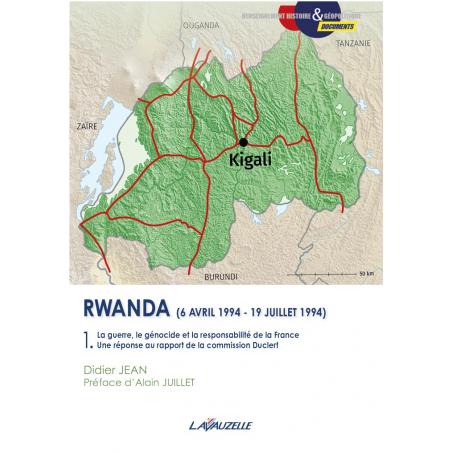
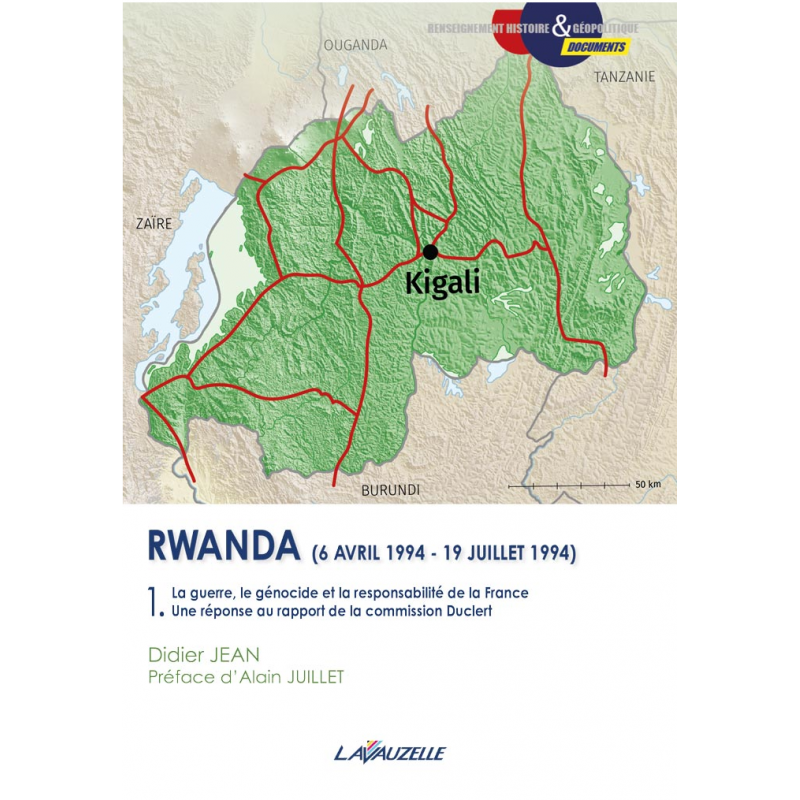
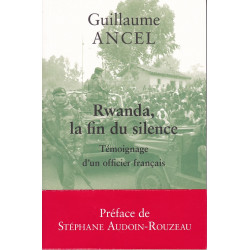
RWANDA (6 April 1994 – 19 July 1994): The War, the Genocide and France's Responsibility
What happened in Rwanda between 6 April and 19 July 1994? What share of responsibility does each of the national and international actors bear for the genocide of the Tutsi?
From the very opening of the book, in order to dispel any ambiguity, a table of a scale of crimes on page 21 rules out any reasoning that would equate the genocide of the Tutsi carried out by the FAR, the Presidential Guard and the Hutu militias with the massacres of Hutu by the FPR.
The FPR's day-by-day offensive and the FAR's resistance, illustrated by numerous maps, the daily progression of the genocide, the FPR's strategy, and the roles of Belgium, Burundi, Uganda, the UN, and the United States are all examined with a contextualisation of each party's responsibilities. Through his well-argued critique of the Duclert report, the author advances a viewpoint that may appear at odds with a multidisciplinary context of historical revisionism. France's role is laid out without indulgence.
After lengthy reflection, the author succeeds in establishing his own truth from the facts he meticulously sets out, supported by a selection of documents and testimonies, taking into account the context and with the hindsight necessary to understand the decisions made by the various actors. Original in both substance and form, written with great freedom of expression, this book sheds a different and singular light on a difficult, complex and unsettling subject.
Didier Jean, holder of a DEA in geopolitics, has been working on a biographical study of General Jeannou Lacaze for several years. In the course of gathering testimonies, he was led to take an interest in the tragic events that unfolded in Rwanda between 6 April 1994 and 19 July 1994. He has also written political fiction featuring General De Gaulle and François Mitterrand.
Secure Payment
Delivery
(+33) 01.79.75.05.50
You might also like